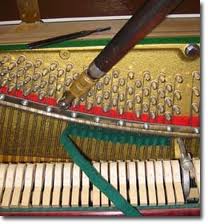


Tuning your piano on a regular basis...........
IS THE MOST IMPORTANT AND THE MOST MISUNDERSTOOD PIANO MAINTENANCE ISSUE!
Similar to oil changes on your vehicle or having your teeth cleaned by a dentist, if a piano is kept up to pitch, it
will increase it's useful life and value tremendously over time.
Having your piano tuned on a regular schedule by a good piano tuner will protect your investment, as well as provide
you with a well-voiced and well-tuned instrument for your greater enjoyment.
FAQ's:
How often should I have my piano tuned?
It is wise to have your piano tuned twice a year.
Ideally, a piano tuned four times a year, according to the seasons, sounds best.
But twice a year is acceptable; once a year is a must!
Why do pianos go out of tune?
"By far, the most important factor causing pianos to go out of tune is the change in humidity from season
to season that occurs in most temperate climates, affecting all pianos, good and bad, new and old, played
and unplayed. The soundboard, glued down around its perimeter and bellied like a diaphragm in the
center, swells up with moisture in the humid season and pushes up on the strings via the bridges on which
the strings rest. This causes the strings to be stretched at a higher tension, raising their pitch. In the dry
season, the opposite happens. The soundboard releases its moisture to the air and subsides, releasing the
pressure on the strings, which then fall in pitch. Unfortunately, the strings don't rise and fall in pitch by
exactly the same amount at the same time. The process is more random than that, with the result that the
strings no longer sound in harmony with one another and need tuning." (Fine, Larry. The Piano Book:
Buying & Owning A New Or Used Piano. Boston: Brookside Press, 4th ed., 2002)
As a practical tuning hint, notice how your piano sounds at different hours of the day. How can it sound so
badly out of tune and squirrelly in the morning, and so beautifully in tune in the afternoon? Keep a written or
mental "log," and you'll notice that your piano comes into "tune" as your room warms to its average temperature.
For the best tuning job, set your thermostat and have your room at its average temperature in time for
your piano technician to begin tuning. Never on a cold morning before the furnace has done its job, or on an
unusually-hot afternoon if you don’t have air conditioning.
Is it true that pianos should never be placed on an outside wall?
In historic homes with single wall construction and drafty, single-pane, windows, keeping the piano away from an
outside wall was good advice. A century ago “Music Parlors” had massive wooden sliding doors that were kept
closed because there was no central heat, just a fireplace in each room. Today’s homes are built with central
heating/air conditioning, adequate insulation, and double-pane-insulated windows that are rated to prevent Ultra
Violet rays from bleaching furniture and ruining drapes. The outside wall factor is no longer important in most
cases. However, never place your piano near a fireplace, stove, or position it over or near a heat register.
Schedule your professional tuning now! Call 608-744-3089 or email: link